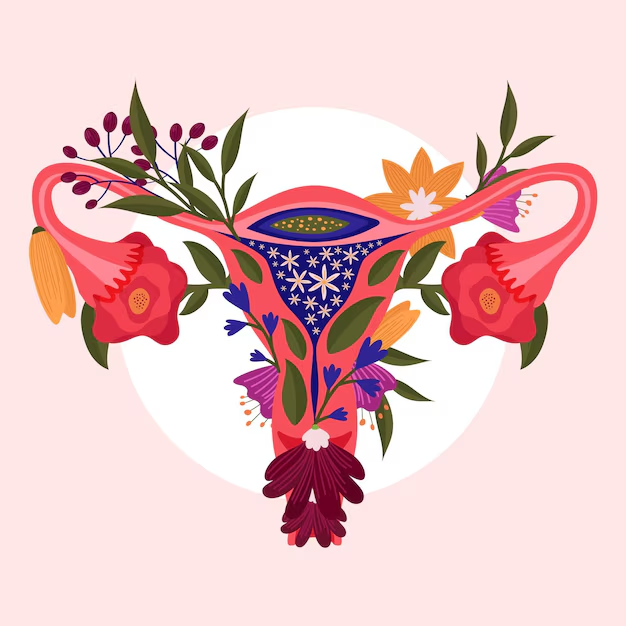
I was thirteen when I got my first period. My friend and I wanted to camp in my front yard, and while setting up the tent I felt the worst pain in my entire life. Mind you I didn’t really know what a period was. There was one time my mom tried to sit me down to give me the puberty talk, but my mom had only had boys up until then. This was her first puberty talk, the female edition. I was fairly young, 9 or 10, when she gave me the speech. This is because my mom got her period when she was 10 years old, and that made her think that I may also start my period young. While I don’t remember all the details of this talk, I do remember her telling me, “like a chicken you will release an egg every month”. At 9 years old this sounded like the most traumatizing thing that could ever happen to me. We had chickens, I saw how big those eggs were. When I heard her say that I was a nervous wreck. I yelled “I don’t want want to be a chicken!”, and that is when the conversation ended and my knowledge of periods remained stuck on the fact that I was destined to lay an egg every month. Fast forward a couple years, I was 13 and I couldn’t be more ready for my period. My best friend had already started hers , so that meant I was ready for womanhood too, right? Wrong. I had no idea what it actually meant to have a period. I knew that it involved bleeding, but that’s where it ended. Going back to when I was 13, in the midst of setting up our tent for the night I felt a stabbing pain in my stomach. I was curled up on our tent floor complaining that my stomach was hurting. I thought maybe I had to go to the bathroom. In the bathroom I realized that the time had come. I was now a woman in my mind. I frantically ran to my mom to tell her, and to find out how to use a pad. We didn’t talk about it, and I went back outside to sleep in the tent.
Now that you know that very personal story about my first period, I want to go into the history of menstrual cycles and how different cultures have perceived the natural bodily function. From there I will discuss how periods are viewed today in the modern western world and how our current lifestyles make it difficult to have a positive menstrual cycle. Finally, in a follow up blog post, I will break down the different phases and how our bodies are changing in the process.
Bleeding Through Time
How incredible is it that as women our bodies are capable of creating life? Whenever that thought dawns on me I realize how beautiful menstruation is. Without it we would not be capable of creating and growing another human. While women everywhere during every time period have been shamed and ostracized for having their monthly bleeds, some cultures believe that menstrual blood can be healing, medicinal, and even holy. In today’s world having a period is hardly celebrated. That hasn’t always been the case if you take a look back in time.
Ancient Egypt
Ancient Egypt was considered quite progressive for their time. Women were independent citizens with many rights, although still less than men due to their economic power. Although being considered the “weaker sex”, women were able to own property, marry whom they chose, and even obtain a divorce. This was not common across many cultures during this time.
Menstruation was taboo in the sense that it was not a topic the men worried themselves with, but more of a woman’s issue that needed to be dealt with privately. Menstrual blood was thought to have been beneficial and even medicinal for women, but not for men. Women could be prescribed by a doctor to rub menstrual blood on her breasts and stomach to help increase the skins elasticity. Many problems women faced during this time were considered ailments caused by the womb. This article here shows different ailments that were presented to a doctor and how they were connected to the womb. Different herbs and oils were prescribed to aid the body in its bleed. For men, menstrual blood was considered “impure”, but for women, it was crucial to their health.
The Cherokee Nation
Many Native American tribes have spiritual connections to menstruation believing that there are fertility goddesses and powers within menstrual blood. The Cherokee Nation have their own sets of beliefs about the monthly bleed. This tribe had much respect for their women. Not only were they responsible for caring for children and the home, but they were the main providers of food. This is because farming was the main source of food for them at the time. Men were in charge of hunting, but due to various reasons hunting wasn’t as reliable as the produce they harvested from the Earth. The women took to the fields and had been very successful at growing their crops. This gave the women more respect since they provided the food to the tribe.
Women were not only respected due to their ability to farm the land but because of their ability to create life. Menstruation was not a considered a dirty and impure thing to take place, but instead they believed it made their women powerful. It is thought that women on their period were capable of deterring natural disasters, warding off evil, and even destroying their enemies. Imagine how the world would view women if this was the case everywhere!
SHHH… Don’t Say Tampon; The Modern World and Menstruation
Today we have scientific answers as to why women experience menstrual cycles. We know that they are a normal bodily function that is necessary to create life. We know that most women that enter puberty will experience around 450 cycles in their life, equating to nearly 10 years of their lifetime. We know that this is not a gross and impure thing women go through, but in today’s society menstrual cycles are still considered taboo and often not discussed, especially around men. This has led to periods being a sensitive topic, so many people don’t know what a tampon tax or period poverty is.
In the US, 1 in 4 teens and 1 in 3 women struggle to afford menstrual products. This is partially due to the tampon tax that is placed on these essential products. The tampon tax is a tax implemented on menstrual products because they are considered nonessential or luxury items. This tax can range anywhere from an additional cost of 4% to 7% in the United States. In America 20 states have this tax in place, but don’t tax items like Viagra or golf club memberships. This unnecessary tax increases the prices of these crucial products making it harder for women to afford them. If a woman cannot afford to purchase her menstrual products then she is unable to go to work during her cycle. This only deepens period poverty in a cruel cycle. Society wants us to not talk about this gender based discrimination because if we did they would have to make a change. New York alone would lose 14 million dollars in revenue annually if they cut this tax, and then they would need to raise prices on other products that may affect people other than women.
There is no education taught on menstrual cycles. The only state that requires schools to teach their students about menstrual cycles is California through the “Know Your Period Act”. Other than California this is not a requirement and therefore is not being taught. Not only should this be taught to every menstruating person, but to every person in general. Boys should learn about menstruating so that the idea of it doesn’t make them so uncomfortable. Women account for half the population, so why shouldn’t men know what their colleagues, bosses, and family are going through on a monthly basis? This education could help men and women understand the female body better rather than be ashamed by it.
We have a lot of work to do when it comes to normalizing periods and embracing the changes that comes with them. I wanted to write this so that some girl out there may not be so scared to speak up about her cycle. The more that periods are talked about the more we learn about them. If I would’ve never talked to anyone about my periods, then I wouldn’t have known that my symptoms were abnormal and I wouldn’t have been diagnosed with PCOS. Get out there and talk about your bleed! Hopefully we can change the stigma around periods, and maybe someday women everywhere won’t be shy about asking for a tampon in public 😉
Thanks for reading!
Xoxo, Ray
Sources
Habiger, Petra. “Menstruation, Menstrual Hygiene and Woman’s Health in Ancient Egypt.” Menstruation in Ancient Egypt, by Petra Habiger, at the Museum of Menstruation and Women’s Health, http://www.mum.org/germnt5.htm. Accessed 15 Mar. 2025.
Armstrong, Kate J. “Blood Magic: A History of Menstruation.” The Exploress, The Exploress, 8 June 2022, http://www.theexploresspodcast.com/episodes/2021/7/28/blood-magic-a-brief-history-of-menstruation#:~:text=In%20North%20America%2C%20the%20Cherokee,to%20the%20world%20at%20large.
“Tampon Tax – Alliance for Period Supplies.” Alliance for Period Supplies – It’s That Time. *, 14 May 2024, allianceforperiodsupplies.org/tampon-tax/.
Nguyen, Angeline. “Tampon Tax: An Additional Economic Burden for Those Who Menstruate: Women’s Health Education Program Blog.” College of Medicine, drexel.edu/medicine/academics/womens-health-and-leadership/womens-health-education-program/whep-blog/tampon-tax/. Accessed 15 Mar. 2025.
Kim. “The Pink Tax: The Cost of Being a Woman – National Organization for Women.” National Organization for Women –, 24 Sept. 2024, now.org/blog/the-pink-tax-the-cost-of-being-a-woman/.
“Period Poverty – Why Millions of Girls and Women Cannot Afford Their Periods.” UN Women, 24 May 2024, http://www.unwomen.org/en/news-stories/explainer/2024/05/period-poverty-why-millions-of-girls-and-women-cannot-afford-their-periods#:~:text=Period%20poverty%20refers%20to%20the,awareness%20to%20manage%20menstrual%20health.
Prabha, Srishti. “California Public School Students Will Be Required to Learn about Menstruation.” Capradio, 25 Oct. 2024, http://www.capradio.org/articles/2024/10/25/california-public-school-students-will-be-required-to-learn-about-menstruation/#:~:text=In%20a%20first%20for%20menstrual,menstrual%20education%20in%20their%20curriculum.

 Eating Right With Ray
Leave a comment